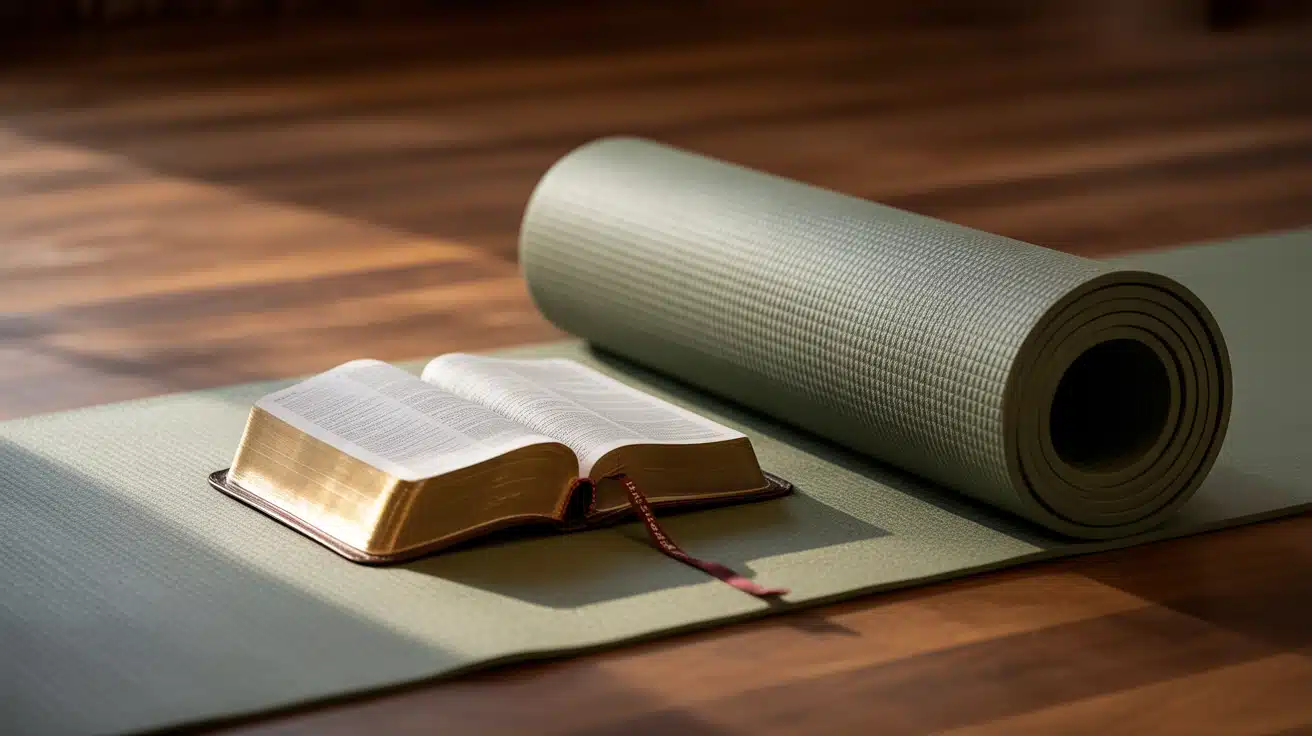
A woman rolls out her mat at a gym class, closes her eyes during a breathing exercise, and suddenly wonders if she just crossed a line with God. That moment of doubt hits millions of Christians every year.
Yoga studios outnumber Starbucks locations in some American cities. But the question keeps coming up in church small groups, comment sections, and late-night Google searches: is this a sin?
The honest answer? Christians cannot agree. Respected pastors and theologians land on opposite sides, and both bring Scripture to the table.
This guide walks through every angle of the debate so you can make your own faith-informed decision based on what the Bible actually teaches.
What is Yoga at Its Core?
The word “yoga” comes from Sanskrit. It means “to yoke” or “to unite.” In its original Hindu context, that union was between the individual soul and Brahman, the divine consciousness.
Yoga was never invented as a workout. It started in ancient India over 5,000 years ago as a spiritual discipline rooted in the Vedas, Hinduism’s oldest sacred texts. The poses, the controlled breathing, the meditation: all of it was built to move a practitioner closer to spiritual awakening.
Terms like asana, pranayama, and chakra are not gym lingo. They are Sanskrit words with deep spiritual meaning tied to Hindu theology and practice.
But here’s where it gets complicated. What most Americans encounter in 2026 barely resembles that original system. Modern yoga shows up in three very different forms:
Secular fitness yoga: This is what you find at most gyms and boutique studios. The instructor cues body positions and breathing patterns. There is no chanting, no spiritual teaching, no mention of deities. It is treated as exercise.
Spiritually immersive yoga: Some studios actively teach Eastern philosophy alongside the poses. Instructors talk about chakra alignment, energy channels, and consciousness expansion. The spiritual framework is the point.
Christian or faith-based yoga: Programs like Holy Yoga and PraiseMoves use physical postures framed entirely within Christian worship. Scripture replaces mantras. Prayer replaces meditation. The physical movements stay, but the spiritual context changes completely.
These three experiences are not the same thing. And collapsing them into a single yes-or-no answer does the conversation a disservice.
What Does the Bible Actually Say?

Let’s start with what should matter most to any Christian asking this question: Scripture.
The Bible never mentions yoga. Not once. It does not appear in any translation or testament. So anyone claiming “the Bible says yoga is wrong” (or right) is applying biblical principles to a practice Scripture does not directly address.
That said, the Bible speaks clearly to the categories this debate falls into. Here are the passages both sides use:
On caring for your body: “Do you not know that your bodies are temples of the Holy Spirit?” (1 Corinthians 6:19). Your physical health matters to God. Stewardship of the body is a biblical value.
On renewing the mind: “Be transformed by the renewing of your mind” (Romans 12:2). Notice the word is “renewing,” not “emptying.” This distinction sits at the center of the meditation debate.
On spiritual discernment: “Test the spirits to see whether they are from God” (1 John 4:1). Believers are told to evaluate spiritual practices, not avoid all engagement with the world.
On Christian freedom: “All things are permissible, but not all things are beneficial” (1 Corinthians 10:23). Liberty exists. But liberty has limits.
On your witness to others: “If what I eat causes my brother to fall, I will never eat meat again” (1 Corinthians 8:13). Your personal freedom matters less than your impact on someone else’s faith.
These verses pull in different directions. That tension is not a flaw; it is by design. The Bible asks you to think, pray, and discern. It does not hand you a checklist for every modern question.
| Bible Verse | Principle | How It Applies |
|---|---|---|
| Exodus 20:3 | Worship God alone | Do not honor other gods through any practice |
| Deuteronomy 12:30-31 | Avoid pagan customs | Be cautious of adopting spiritual rituals from other religions |
| 1 Corinthians 10:31 | Glorify God in everything | Your motivation defines whether an action honors God |
| Colossians 3:17 | Do all in Christ’s name | Keep Jesus at the center of what you practice |
| 1 Thessalonians 5:21 | Test everything | Examine practices carefully before committing to them |
| Romans 14:13 | Don’t cause others to stumble | Consider how your choices affect weaker believers |
The Case Against Yoga: Why Many Christians Say No
This position carries real theological weight. It is held by seminary presidents, prominent pastors, and former yoga practitioners who walked away after converting to Christianity. Here is their argument.
The Poses Were Designed for Worship
The physical postures in yoga were not invented for fitness. They were created as acts of devotion to Hindu deities. According to former psychic and Christian convert Jenn Nizza, writing in the Christian Post, the positions practitioners take are forms of worship directed toward other gods.
With over 330 million deities in Hinduism, critics argue that each traditional pose carries a spiritual tribute baked into its design.
Scripture is direct here. Deuteronomy 32:17 says sacrifices to false gods are sacrifices to demons. Paul echoes this in 1 Corinthians 10:20. Romans 12:1 calls Christians to present their bodies as a living sacrifice to God alone.
For this camp, the logic is simple: if a posture was built to worship a false god, performing it in Lululemon pants does not undo its purpose.
Kundalini Energy and the Serpent Problem
This is where the debate gets intense. Kundalini yoga specifically aims to awaken a coiled, serpent-like energy said to rest at the base of the spine. Through breathing and postures, this energy supposedly rises through the body’s chakra system toward spiritual awakening.
For Christians, the serpent symbolism is impossible to ignore. Genesis 3 establishes the serpent as the vehicle of deception. Jenn Nizza, who spent years practicing yoga as part of occult rituals before her conversion, has warned publicly that even seemingly harmless breathing techniques like Lion’s Breath were designed to invoke spiritual forces outside of God.
Not every yoga class teaches Kundalini. But the fact that one of yoga’s major branches is built around awakening serpent energy gives many Christians serious pause.
Mind-Emptying Contradicts Mind-Renewing
This is one of the sharpest theological objections. Yoga’s meditative goal, across most traditional schools, is to quiet or empty the mind. Clear the thoughts. Find stillness in the void.
Christianity teaches the opposite. Romans 12:2 says transformation comes through renewing the mind, filling it with truth. Philippians 4:8 tells believers to actively think about what is true, noble, right, pure, lovely, and admirable.
2 Corinthians 11:14 adds a warning: Satan disguises himself as an angel of light. The inner peace and light that yoga meditation promises, critics argue, can be a counterfeit spiritual experience that feels authentic but pulls believers away from the true source.
Named Voices Against Yoga
This is not a fringe position. Al Mohler, president of the Southern Baptist Theological Seminary, has publicly stated that yoga contradicts Christianity. Pastor Vladimir Savchuk has called yoga “100% against Christian beliefs.” Mark Driscoll has labeled it “absolute paganism.”
Laurette Willis, a certified personal trainer who spent 22 years in yoga and New Age practices before becoming a Christian, went further. She created PraiseMoves as what she considers a biblical alternative, arguing that the physical and spiritual elements of yoga cannot be separated.
Rebranding Does Not Change What it is
A popular compromise has been “Holy Yoga,” where studios overlay Christian music, prayer, and Scripture onto traditional yoga sessions.
Theological critics reject this approach. GotQuestions.org, one of the most-visited Christian reference sites, argues that placing Christian elements on top of a practice with non-Christian spiritual architecture does not cleanse it. The structure underneath stays.
Colossians 2:8 warns about being taken captive through “hollow and deceptive philosophy, which depends on human tradition rather than on Christ.” For this camp, relabeling is not the same as redeeming.
The Case for Yoga: Why Other Christians Say Yes

The other side of this debate is equally grounded in Scripture, held by committed believers, and logically consistent. Here is their argument.
Origin Does Not Determine Spiritual Reality
Christmas trees have pagan roots. So does the name “Easter.” Wedding rings trace back to pre-Christian traditions. Yet the Church redeemed all of them. The argument: God created the human body and its capacity for movement. Physical postures cannot be inherently evil. What matters is the intention of the person performing them.
The “meat Sacrificed to Idols” Framework
Paul’s teaching in 1 Corinthians 8-10 is the theological anchor for this position. Early Christians faced a real question: could they eat meat that had been offered to pagan idols in the marketplace?
Paul’s answer was nuanced. The idol is nothing. The meat is just meat. But if eating it causes a weaker believer to stumble, skip it. The parallel to yoga: a stretch is just a stretch. A breathing exercise is just breathing. But context and conscience matter.
The Evangelical Alliance, one of the UK’s largest evangelical bodies, applied this logic directly. They compared yoga to going to a pub on Friday night. It does not lead you toward God. But it does not automatically pull you away either, as long as you walk in with your eyes open and your faith intact.
Some Believers Say Yoga Drew Them Closer to God
This is the part that makes the debate so difficult to flatten into a simple answer. Multiple Christian yoga practitioners, including teachers within the Holy Yoga movement, report that the practice created space for prayer, physical gratitude, and a deeper awareness of God’s presence in their bodies.
They are not describing a drift toward Hinduism. They are describing a physical practice that, for them, became an act of worship directed at Christ.
Freedom in Christ is a Real Biblical Category
Galatians 5:1 says Christ set believers free. Paul repeats in 1 Corinthians 10:23 that all things are permissible. The pro-yoga camp takes this seriously: Christians have the liberty to make personal choices about activities that do not directly violate Scripture. And since Scripture never mentions yoga, this falls into the category of personal conscience.
The Third Position: “It Depends” Is Actually the Most Biblical Answer
Most honest conversations about this end up here. And it may be the most faithful position of the three.
Not every yoga class carries the same spiritual weight. A 45-minute stretching session at Planet Fitness, with pop music playing, is fundamentally different from a guru-led retreat where Hindu philosophy is taught as truth.
Treating them as identical oversimplifies a genuinely complex question.
Here is what the middle ground asks you to consider before walking into any class:
Is the instructor teaching Eastern spirituality, or is this a fitness class? There is a real difference between “breathe deeply” and “open your third eye.” Know which one you are signing up for.
Are you theologically grounded enough to filter what you hear? A new believer and a lifelong student of Scripture will have different levels of spiritual armor. Both should be honest about where they stand.
Could your participation confuse someone watching? The stumbling block principle from Romans 14 is not hypothetical. If a younger believer sees you in a yoga class and takes that as permission to attend one with heavy spiritual content, your freedom just became their confusion.
What is your actual reason for being there? Physical fitness, stress relief, and better flexibility are legitimate health goals. Spiritual exploration outside of Christianity is not.
This is what discernment looks like in practice. Not a blanket rule. A set of honest questions you ask yourself before you step on the mat.
Also read: Is Yoga a Religion or a Spiritual Practice?
How to Decide: A 7-Step Framework
If you are a Christian trying to land on this question, work through these steps honestly:
- Check your foundation. Are you grounded enough in your faith to engage with spiritually complex spaces without being pulled off course?
- Research the specific class. Visit the studio’s website. Read the instructor’s bio. Look for language about energy work, chakra alignment, or spiritual awakening. If it is there, that tells you what you are walking into.
- Set your intention before you arrive. Physical wellness. Full stop. If you catch yourself drifting toward spiritual curiosity about non-Christian concepts, that is your signal.
- Build a personal filter. Know what you will do when non-Christian elements come up. Pray silently. Redirect your thoughts to Scripture. Or simply opt out of that moment. Have a plan.
- Think about your witness. How will this be seen by others in your church, your family, or your community? You may have freedom. But stewardship of that freedom means considering its ripple effects.
- Pray about it. Not as a formality. Sit with God and ask for clarity. James 1:5 promises wisdom to those who ask.
- If you feel uneasy, explore alternatives. Pilates, PraiseMoves, physical therapy stretching, prayer walks, or simple bodyweight routines all deliver the physical benefits without the spiritual complexity.
Christian Alternatives Worth Trying
If traditional yoga raises concerns for you, here are options that give you the physical benefits without the theological tension:
PraiseMoves: Created by Laurette Willis after she left 22 years of yoga and New Age practice. It replaces yoga’s spiritual framework entirely with Scripture-based movements and worship. It is the most established Christian alternative on the market.
Holy Yoga: Uses traditional yoga postures but frames the entire experience within Christian worship. Sessions include Scripture meditation, prayer, and Christ-centered instruction. This sits in the “redeem the practice” camp.
Pilates: Originally developed by Joseph Pilates for physical rehabilitation. No spiritual roots. Strong focus on core strength, flexibility, and body control.
Stretching and mobility classes: Many physical therapists and personal trainers offer stretching programs that deliver yoga-equivalent flexibility benefits with zero spiritual content.
Prayer walks: For Christians who want a meditative physical practice, walking while praying combines movement, fresh air, and time with God in a way that has no theological baggage whatsoever.
Conclusion
Christians will keep debating this. That is okay. This is not a salvation issue. It is a Romans 14 issue, a matter of personal conscience where sincere believers land on different sides.
What matters is that your decision comes from an informed place, grounded in Scripture, shaped by prayer, and honest about your own spiritual maturity.
If yoga creates space for you to worship God through physical stewardship, and your conscience is clear, that is between you and him. If it raises doubts, those doubts are worth honoring. God gave you discernment for a reason.
Whatever you decide, let it strengthen your faith, not weaken it. That is the test that actually matters.
Frequently Asked Questions
Does the Bible Say Not to Do Yoga?
The Bible never mentions yoga directly but warns against adopting spiritual practices from other religions.
What God is Worshipped in Yoga?
Shiva is considered the patron god of yoga in Hinduism, known as Adiyogi, the first yogi.
Is Yoga a Spiritual Practice or Just Exercise?
It depends on the class. Traditional yoga is spiritual. Many Western studios focus purely on physical fitness.
What Does the Church Say About Yoga?
Churches are divided. Some warn against it. Others accept it when practiced purely for physical health.
What are Christian Alternatives to Yoga?
PraiseMoves, Holy Yoga, Pilates, stretching classes, and prayer walks all offer similar physical benefits.
Can You Do Yoga Poses without the Spiritual Part?
Many Christians believe you can separate the physical movements from the spiritual context. Others disagree.