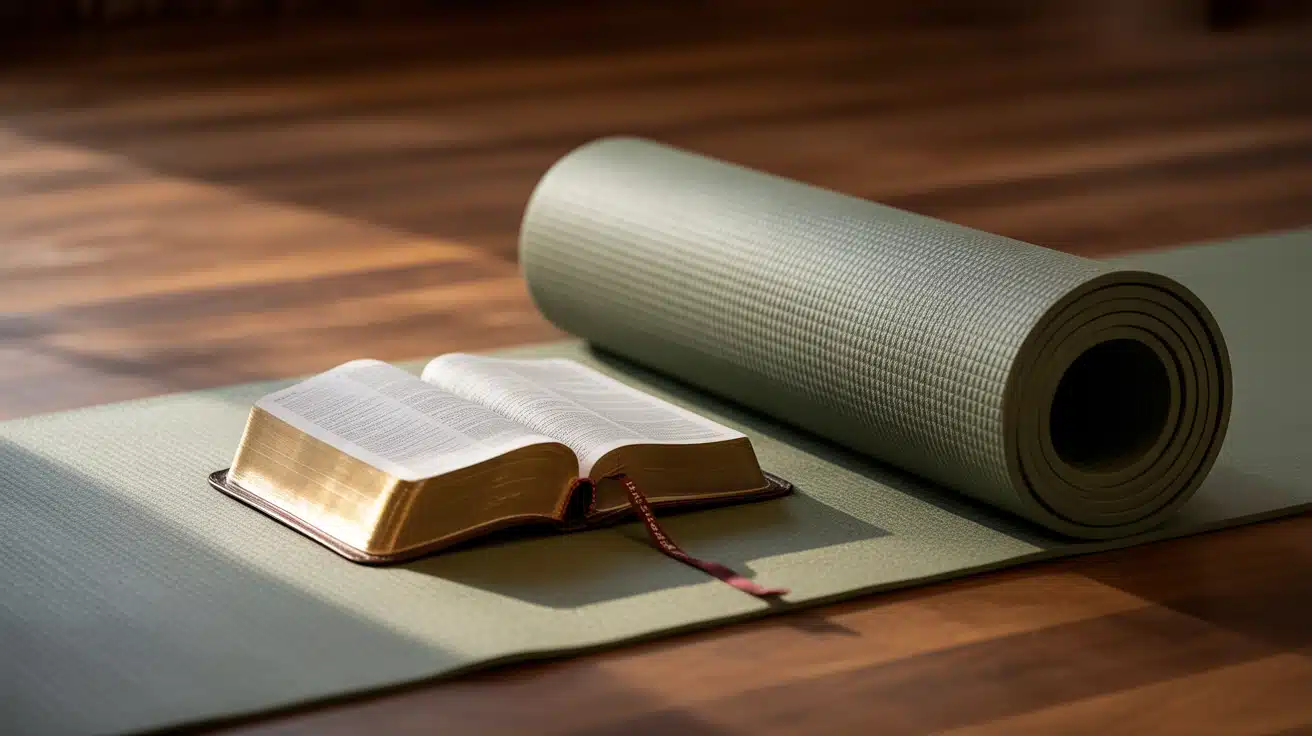
Every morning, millions of people worldwide roll out their mats, move through postures, and breathe with intention, yet most never stop to ask: What exactly am I practicing? Is yoga a religion? A fitness routine? Something far deeper? If you have ever wondered the same thing, you are not alone.
The answer is neither simple nor singular. Yoga sits at a fascinating crossroads of history, philosophy, and personal faith.
While gyms have repackaged it as a workout, ancient texts tell a completely different story.
So let us cut through the noise, hear from expert voices across faith traditions, and get to the honest answer this question genuinely deserves.
What Makes Something a “Religion” in the First Place?
Before we label yoga anything, we need to ask a more fundamental question: what does religion actually mean?
Sociologists and theologians generally agree that religion involves organized doctrine, mandatory belief in a deity, sacred rituals, conversion, and an institutional hierarchy, think First Communion, the Five Pillars of Islam, or Bar Mitzvah.
Here is the thing: yoga doesn’t check any of these boxes. There is no required deity to worship, no conversion process, no singular holy book, and no governing religious body.
Georg Feuerstein, author of The Shambhala Encyclopedia of Yoga and one of the foremost scholars of the yoga tradition, is direct on this point: yoga proposes no gods or saviors and proceeds based on experiential confirmation rather than religious faith.
That alone might settle it for some of you, yet the conversation is far richer than a simple verdict.
Yoga’s Ancient Roots: Spiritual, Not Religious

To really understand what yoga is, we have to go back, way back.
Yoga traces back to India’s Vedic period, roughly 1500 BCE. Critically, the Vedas carry a spiritual rather than strictly religious orientation.
Researcher Christopher Wallis notes that early yoga existed alongside traditions like Buddhism, Jainism, and Shaivism as a non-religious spiritual tradition, distinct from organized religion even then.
Patanjali’s Yoga Sutras, compiled around the 2nd century CE, formalized yoga into eight limbs, each rooted in Sanskrit terms that carry far more meaning than their physical translations suggest.
Of these eight limbs, only one refers to physical postures. The remaining seven cover ethical disciplines, breath control, sense withdrawal, concentration, meditation, and ultimately the state of pure consciousness.
Think about that for a moment. Modern Western yoga has spotlighted the one physical limb while quietly sidelining seven profoundly transformative ones.
Yoga as a Spiritual Practice: Beyond the Mat

Here is a distinction worth sitting with: spirituality and religion are not the same thing. Religion is institutional; spirituality is personal. And yoga belongs squarely in the latter category.
India’s Ministry of External Affairs defines yoga as a spiritual discipline based on an extremely subtle science that focuses on bringing harmony between mind and body, adding that it does not adhere to any particular religion, belief system, or community. Anyone can practice, regardless of faith, ethnicity, or culture.
Yoga teacher Virginia Compton puts it beautifully from lived experience: for her, yoga is absolutely a spiritual practice, and she encourages students to direct the devotional aspect of their practice however resonates most naturally with them, toward a deity, an energy, or simply toward themselves.
The sacred symbols in yoga, Om, the lotus, and the hamsa, are not decorative choices. They carry centuries of layered meaning that most fitness-focused classes never even touch.
How Different Faith Traditions View Yoga

Yoga means different things depending on where you stand spiritually, and no single tradition holds the full picture.
Here are three major perspectives on it.
1. The Hindu Perspective
Yoga and Hinduism share Vedic roots, but they are not identical. Deepak Chopra argues that yoga predates classical Hinduism, rooted in consciousness and consciousness alone.
While the Hindu American Foundation rightly calls yoga one of the greatest gifts of Hinduism to mankind, South Asian yoga teachers widely affirm that it is a practice anyone is welcome to engage in, regardless of their own religion.
2. The Christian Perspective
Christian responses to yoga span a wide spectrum, and this is where the debate gets particularly interesting.
The question of whether yoga conflicts with Christianity is one that theologians, priests, and everyday believers continue to wrestle with, and the answers vary dramatically depending on who you ask.
Albert Mohler, president of Southern Baptist Theological Seminary, has condemned it as incompatible with Christianity.
At the other end, Father Thomas Ryan, a Paulist priest and author of Prayer of Heart and Body, has practiced and taught yoga for decades as a Christian spiritual discipline, describing it as a software program to plug into the hardware of one’s own faith.
3. The Secular Perspective
For millions of people, yoga is primarily a tool for physical health, reducing stress, improving flexibility, and building strength. These benefits are real and well-documented.
However, Gary Kraftsow, founder of the American Viniyoga Institute with over 30 years of teaching experience, cautions against stripping it entirely bare.
Yoga was never secular, traditionally. It was always connected to spirituality.
The Westernization Problem
Now here is where it gets uncomfortable for many modern practitioners.
As yoga exploded in popularity across the West, it underwent a significant transformation, shifting from a holistic spiritual science into a studio fitness product.
What was once an eight-limbed path toward liberation has, in many studios, been condensed into a flowing sequence of postures.
Even vinyasa yoga, which draws its name from Sanskrit, is often taught with little reference to the philosophical system from which it emerged.
Author Susanna Barkataki describes authentic yoga as a practical, structured, scientific framework that aims at curing our personal and social ills, a far cry from what most modern classes offer.
A teacher who closes class with Namaste but cannot explain what Namaste means is a small but telling symbol of how far the practice has drifted from its origins.
So, Is Yoga a Religion? The Honest Answer
Let us bring it all together.
No, yoga is not a religion. But it is profoundly more than exercise.
It is a spiritual discipline and philosophical system that has coexisted with and enriched multiple religious traditions across thousands of years.
As Dr. Mary Pullig Schatz aptly put it, just as practicing karate does not require becoming a Buddhist, practicing yoga does not require adopting Hinduism.
What yoga does require, at its authentic core, is a willingness to turn inward, to examine the mind, regulate the breath, and seek a deeper awareness of the self and its relationship to something greater.
Whether you call that God, Universal Consciousness, or simply stillness, yoga provides the path. The destination, and the faith you carry there, remains entirely your own.
Conclusion
Yoga resists easy labels, and honestly, that is precisely its genius. It is not a religion demanding conversion, nor a workout demanding only sweat.
It is a living, breathing spiritual science refined over millennia, designed to unite the mind, body, and consciousness in ways no gym class ever could.
Whether you practice for flexibility, stress relief, or a deeper sense of meaning, you are participating in something ancient and vast.
And perhaps that is the most honest takeaway of all: approach yoga with curiosity, respect its roots, and allow it to meet you exactly where you are, spiritually, physically, and philosophically.
Frequently Asked Questions
Can Yoga Lower Blood Pressure?
Yes, yoga can lower blood pressure by reducing stress, improving circulation, and promoting relaxation through breathwork (pranayama) and gentle poses.
Is It Okay for Christians to Do Yoga?
Yes, many Christians practice yoga, viewing it as a beneficial form of exercise and a way to enhance spiritual discipline through breathwork and mindfulness.
Is Yoga Better than Walking for Heart Health?
Yoga is more effective than walking in improving cardiac function in older people with high PP.
Is Yoga a Form of Prayer?
Yoga is a prayerful practice. Whether or not you intend it to be one, yoga is a spiritual practice.
Do Yogis Believe in God?
According to yogis, God exists as the Absolute Truth, and it is due to this existence that everything else can exist