After weeks of back-to-back deadlines and barely seeing each other awake, a couple realized their usual dinner-and-movie routine wasn’t cutting it anymore.
They needed something that would help them actually connect with something tactile, present, and different from staring at another screen together.
Body-to-body massage is a relaxation technique in which the practitioner uses their entire body, not just their hands, to apply pressure through skin-to-skin contact and gliding movements.
Let’s address what you’re probably thinking: this topic exists in an awkward space between legitimate wellness practice and adult entertainment.
This guide treats body-to-body massage as a legitimate relaxation practice that requires the same respect, technique, and safety considerations as any other form of physical therapy.
Also read: What is Yoni Massage? Benefits & Safety
What Is Body to Body Massage?
Body-to-body massage uses full-body contact, torso, limbs, and controlled body weight, rather than just hands, to deliver pressure and flowing movements.
The practitioner applies oils or gels to enable smooth, gliding skin-to-skin contact, targeting relaxation through sustained sensory input and distributed pressure across large muscle groups.
This approach differs significantly from conventional massage methods and exists in both wellness and sensual service contexts.
Body-to-Body Massage Origins & Cultural Roots
Body-to-body massage didn’t start in 1990s Japan; it has roots across multiple ancient cultures, each understanding that sustained skin contact affects the nervous system differently than isolated hand techniques.
Ancient Foundations Nobody Talks About
1. India: Abhyanga & Ayurvedic Touch. 5,000-year-old Ayurvedic texts prescribed Abhyanga as daily medicine, a full-body oil massage using forearms and body weight to calm the nervous system through sustained sensory input.
2. Japan: From Soaplands to Global Practice. Modern body-to-body massage emerged from the 1990s Yokohama adult entertainment venues. Practitioners developed Nuru gel, enabling friction-free gliding. By the 2010s, it existed in two parallel worlds: adult services and legitimate wellness, using identical techniques with different boundaries.
3. China: Taoist Energy Principles. Traditional Chinese medicine used sustained full-body contact to move Qi through meridians. Extensive surface contact simultaneously opens multiple energy pathways, affecting emotional regulation.
Misconceptions Regarding Body-to-Body Massage
Most people come to this topic with assumptions shaped by late-night ads and questionable spa listings. Here’s what body-to-body massage actually is and isn’t:
Misconception 1: “This is just coded language for sex work.”
Reality: Body-to-body massage exists across multiple contexts, from legitimate wellness practices to adult services.
Misconception 2: “Professional and partner practice are basically the same thing.”
Reality: Night and day difference. Professional body-to-body massage is performed in licensed facilities by trained staff. Partner practice is an intimacy tool for established couples in private settings.
Misconception 3: “Any full-body contact automatically becomes sexual.”
Reality: Intent and boundaries create the experience. Physical therapists manipulate bodies daily without a sexual context.
What Happens During a B2B Massage?
Whether you’re curious about booking a professional session or considering trying techniques at home with a partner, knowing what to expect helps you make informed decisions.
Professional Setting vs. At-Home Practice
Most guides only cover one scenario. Here’s how they actually compare:
| Aspect | Professional Session | At-Home with Partner |
|---|---|---|
| Duration | 60-90 minutes | 20-45 minutes |
| Setup | Specialized room, waterproof surfaces | Bathroom floor, air mattress, or shower |
| Products | Professional-grade Nuru gel | Coconut oil works fine to start |
| Clothing | Minimal/none | Whatever you’re comfortable with |
| Cost | $150-400+, depending on location | $20-50 in supplies |
The Typical Flow (Professional)
Timeline breakdown:
- 0-10 min: Arrival, consultation, both parties shower
- 10-20 min: Warm oil application, initial relaxation positioning
- 20-50 min: Full body-to-body gliding technique
- 50-70 min: Transition to traditional hand strokes, remarkable down
- 70-90 min: Rest period, hydration, gradual departure
What First-Timers Actually Experience
1. Initial awkwardness: completely usual, typically fades within 5 minutes as you settle into the rhythm
2. Temperature awareness: Two bodies generate significant heat rooms are kept cooler than you’d expect
3. Unexpected ticklishness: Common on ribs, feet, and inner thighs. Professional practitioners adjust pressure or skip those areas temporarily
4. The “melting” sensation: Around the 20-minute mark, most people report a shift from hyper-awareness to deep relaxation as their nervous system fully engages.
How to Do a Body-to-Body Massage
Learning body-to-body massage techniques can enhance intimacy between partners. This guide covers essential steps for beginners, emphasizing safety, technique, and communication.
Setup
- Warm room (75-80°F), waterproof mat/towels, dim lighting, calming music
- Supplies: massage oil (coconut, jojoba, almond), extra towels, water
Hygiene & Consent
- Both shower, trim nails
- Discuss boundaries and safe word
- Confirm mutual comfort
Body to Body Massage Beginner Techniques (Start Here)
Technique 1: The Back Glide
Position: Receiver face-down, giver kneels alongside
Movement: Place chest on receiver’s upper back, slide slowly down spine to lower back
Hands: Use only for balance on the mat, not on the receiver
Duration: 2-3 minutes per pass
Common mistake: Going too fast halves whatever speed feels right
Technique 2: The Full Body Slide
Position: Giver at receiver’s head, facing their feet
Movement: Glide the entire torso down the receiver’s back, legs straddling or to one side
Pressure: Light to medium, let gravity provide pressure, don’t push
Duration: 3-4 minutes, repeat 4-5 slides
Technique 3: Side-to-Side Rock
Position: Lie diagonally on the receiver’s back
Movement: Gently rock side-to-side, creatinga wave-like motion
Focus: Synchronize breathing together
Duration: 2-3 minutes
Intermediate Techniques (After 3-4 Sessions)
Technique 4: Limb Integration
Use an oiled forearm to glide from the shoulder to the fingertips, with arms extended. For legs, slide your calf along theirs from ankle to thigh.
Technique 5: The Flip Transition
Signal verbally: “I’m going to have you flip over now.” Maintain hand contact on the shoulder or hip during rotation. Reapply oil before continuing with lighter pressure on the front body.
Communication Scripts That Actually Work
Before starting: “If anything feels uncomfortable, say ‘pause,’ and I’ll stop immediately.”
During session: “How’s this pressure?” “I felt you tense. Should I lighten up?”
For receivers: “Can you use less pressure here?” or “That’s perfect.”
After session: “What felt best?” “Anything to adjust next time?”
Key principle: Simple, direct phrases work best. Silence is usual; speak only when an adjustment is needed.
Don’t let fear of “ruining the moment” prevent you from speaking up. Clear boundaries and ongoing consent create safety, and safety enables genuine relaxation.
Benefits of Body-to-Body Massage
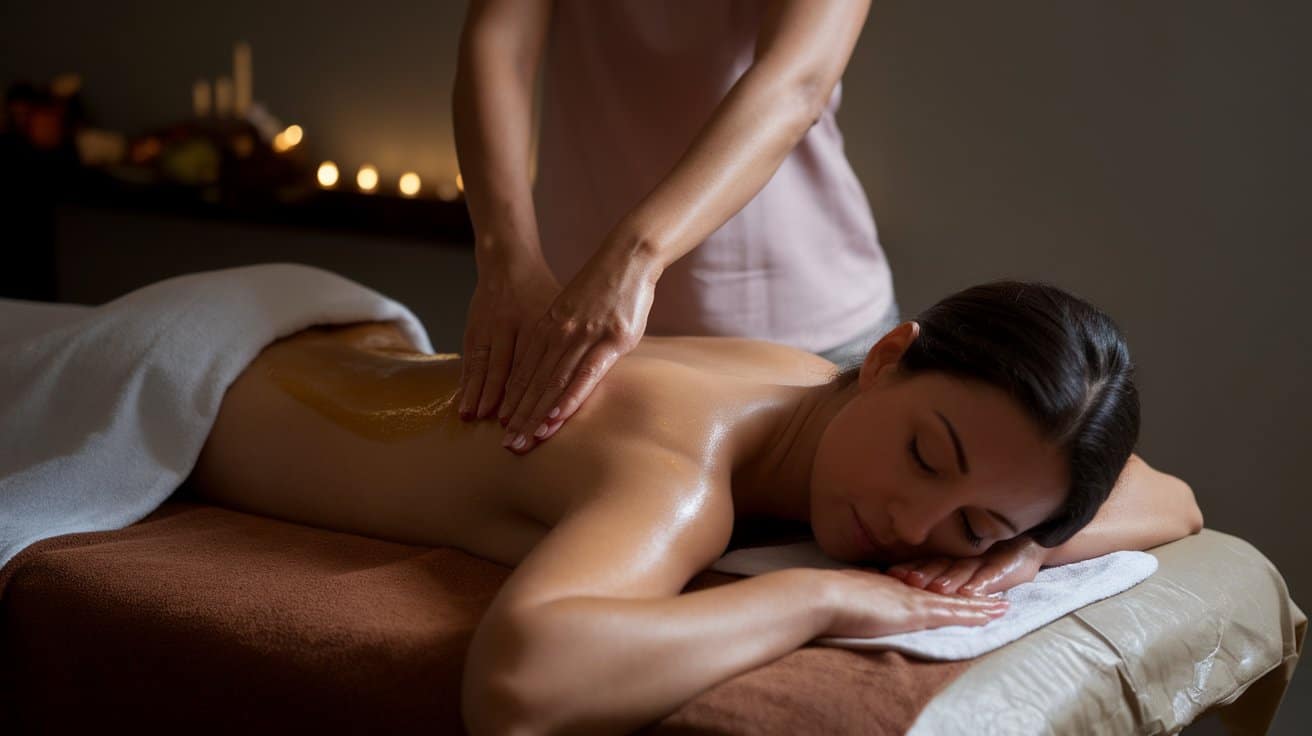
Body-to-body massage offers several potential benefits, though research on this technique is limited compared to that of traditional massage therapies.
1. Stress Hormone Reduction – Touch therapy reduces cortisol by 20-31%. Sustained whole-body contact triggers your parasympathetic “rest and digest” response.
2. Oxytocin Release – Research in Psychoneuroendocrinology confirms skin-to-skin contact releases oxytocin, the bonding hormone that counteracts stress and reduces anxiety for hours.
3. Muscle Tension Relief – Broad pressure distribution relaxes fascia. Not a replacement for therapeutic massage, but effective for general tension.
4. Improved Circulation – Mayo Clinic confirms massage increases blood flow, delivering oxygen and nutrients to tissues.
5. Better Sleep Quality – Reduced cortisol plus increased serotonin creates favorable sleep conditions.
6. Heightened Intimacy – Couples report feeling more connected, but no controlled studies exist.
7. Sensory Awareness – C-tactile nerve research suggests slow touch creates comfort and pleasure, but studies are still emerging.
While body-to-body massage offers potential benefits for relaxation, intimacy, and sensory awareness, it’s important to note that these advantages are based primarily on general touch research rather than specific clinical studies.
Common Mistakes That Ruin the Experience
Most guides tell you what to do. Here’s what not to do: mistakes that turn relaxing sessions into awkward disasters.
Mistakes Givers Make
1. Rushing Through It: This requires a minimum of 30-45 minutes. Your partner’s nervous system needs time to shift into a state of relaxation. Rushing triggers stress, not calm.
2. Too Much Pressure Too Soon: Start with 25% body weight, gradually increase over 10-15 minutes. Think “melting into them,” not “pressing down.”
3. Forgetting to Breathe: When you hold your breath, concentrating, they unconsciously mirror your tension. Take slow, deep breaths deliberately.
4. Neglecting Oil Reapplication: Reapply every 7-10 minutes. Friction ruins everything; brief pauses to add oil don’t break relaxation.
5. Talking Too Much: Constant questions keep their analytical brain engaged. Establish check-in moments every 10 minutes instead of narrating everything.
Mistakes Receivers Make
6. Staying in Their Head: Overthinking prevents relaxation. Focus on physical sensations, warmth, pressure, movement, and do not judge the experience.
7. Not Communicating Discomfort: Suffering silently helps no one. One clear “Can you lighten the pressure?” prevents 20 minutes of discomfort.
8. Expecting Perfection: First attempts are awkward. That’s normal. Awkwardness decreases dramatically by the third session.
Setup Mistakes
9. Wrong Surface: Beds absorb oil and create instability. Use a waterproof mat on a padded floor, not a bed or a hard surface.
10. Poor Temperature: Set the room to 75-78°F. Starting cold prevents relaxation.
11. No Cleanup Plan: Have towels, a clear path to the shower, and a laundry basket ready before starting.
Remember, awkward first attempts don’t predict future success; they’re simply part of the process.
Body to Body Massage Vs Sensual Massage Vs Other Massages
Understanding these differences helps you choose the service that best meets your needs.
Body-to-Body Massage: B2B massage is a technique in which the therapist uses their entire body, not just their hands, to apply pressure through direct skin contact and gliding movements.
Skin-to-Skin Massage: Skin-to-Skin massage is any massage that involves direct body contact without clothing barriers between the therapist and the client. It can appear in both wellness and sensual contexts.
Sensual Massage: Sensual massage focuses on pleasure and intimacy through gentle touch, ranging from couples therapy practices to adult entertainment services.
Nuru Massage: Nuru massage is a Japanese body-to-body technique that uses a special seaweed-derived gel to create a slippery surface for smooth, full-body gliding movements.
Body Rub: an informal term for a full-body contact massage using oils or gels. Often used interchangeably with body-to-body massage, typically signaling non-therapeutic services.
Traditional Massage: Traditional massage is therapeutic bodywork using the hands, forearms, and specific techniques (such as Swedish and deep tissue) to relieve muscle tension, improve circulation, and address pain. Practiced by licensed therapists.
| Massage Type | How It’s Done | Purpose | Regulation |
|---|---|---|---|
| Traditional Massage | Hands, forearms, using specific strokes | Therapeutic muscle relief, injury rehab | Highly regulated, 500-1000-hour training |
| Body-to-Body Massage | Entire body surface with gliding movements | Sensory experience, relaxation | Grey area, inconsistent standards |
| Skin-to-Skin Massage | Direct body contact without clothing | Intimate relaxation | Minimal to no regulation |
| Sensual Massage | Gentle, pleasure-focused touch | Emphasize pleasure and intimacy | Largely unregulated |
| Nuru Massage | Whole body using seaweed gel for slippery gliding | Unique sensory experience | Not standardized |
| Body Slide/Body Rub | Complete body contact with oils or gels | General or sensual relaxation | Typically unregulated |
Traditional massage has clear therapeutic goals and professional standards, while other types range from wellness practices to adult entertainment with minimal regulation.
Safety, Ethics & Boundaries in Body to Body Massage
Safety and consent are non-negotiable in body-to-body massage due to the intimate nature of full-body contact. This section addresses essential precautions often overlooked.
Consent & Communication
Discuss boundaries explicitly before starting, specify comfortable and off-limit areas. Establish a safe word or tap signal to pause/stop immediately. Check in regularly during the session: “Is this pressure okay?”Watch for non-verbal discomfort cues. Respect immediate stops without question.
Hygiene & Health Precautions
Both parties shower thoroughly beforehand. Use clean sheets, towels, and mats. Trim and file nails smooth. Remove jewelry.
Avoid If Either Person Has: Skin infections, open wounds, or contagious conditions, severe sunburn, undiagnosed rashes, or certain health conditions.
Oil Selection: Patch test 24 hours before. Use hypoallergenic options (coconut, jojoba, almond). Check for nut allergies and ingredient sensitivities.
Professional vs. Personal Practice
Seek Licensed Therapists For: Therapeutic needs, professional standards, clear boundaries, and insurance-covered services.
Personal Practice: Legal between consenting adults in private. Requires equal enthusiasm from both partners, never involves pressure or obligation.
Red Flags: Establishments without clear credentials or service descriptions, unlicensed practitioners claiming therapeutic benefits, suggestive advertising without professional licensing.
Safety encompasses physical precautions, consent, and ethical practice. Whether professional or personal, prioritizing these elements protects everyone and ensures positive, respectful experiences.
Conclusion
Body-to-body massage sits at the intersection of relaxation, intimacy, and wellness. When approached with respect and clear communication, it offers genuine stress relief and a deeper connection between partners.
Start slow with basic techniques like the back glide. Master fundamentals before progressing.
Communication matters far more than perfect execution. A session where both people feel comfortable speaking up will consistently outperform technically flawless silence that leaves someone uncomfortable.
Every couple’s practice looks different, and that’s fine. Approach it as a shared journey rather than a performance to master. Focus on trust, presence, and care over perfection of technique.
Frequently Asked Questions
What Should You Wear to a B2B Massage?
For a B2B or typical massage, wear loose, comfortable clothing, such as joggers or yoga pants, and a soft top.
Can a Massage Therapist Massage the Groin Area?
Yes, a massage therapist can work on the groin area for therapeutic reasons like pain relief, but it requires explicit client consent.
What Is an Arousal Massage?
An arousal massage, also known as an erotic or sensual massage, is a massage focused on increasing sexual stimulation, pleasure, and intimacy, often by stimulating erogenous zones like genitals or breasts.